
Every year during the month of Suro, two villages in Banyuwangi transform. Men smeared in black paint, wearing fake horns, move and behave like buffalo as they're paraded through the village amid cheering crowds and the scent of incense. This is Kebo-keboan — one of the most iconic ceremonies of the Osing people, blending gratitude for the harvest, a plea to ward off misfortune, and reverence for ancestors into a single ritual dense with meaning.
This article looks at the origins, symbolic meaning, procession stages, and the differences between the two villages that still keep the Kebo-keboan tradition alive today.
What Is Kebo-keboan?
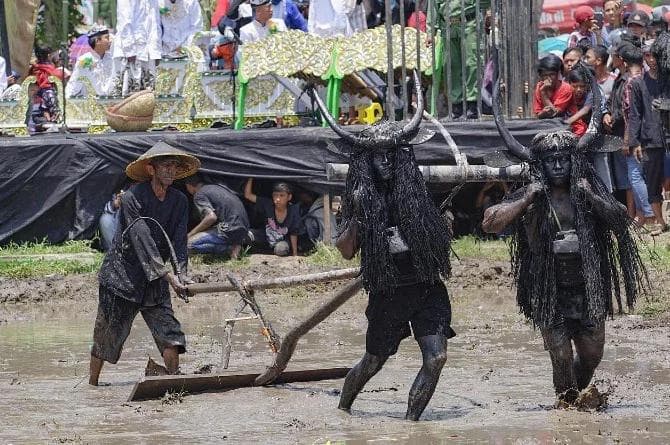
Literally, Kebo-keboan means "imitation buffalo" — in this ceremony, a number of villagers are dressed to resemble buffalo, their bodies painted black and fitted with horns and fake hair. The Kebo-keboan ceremony represents the Osing community's gratitude for the harvest they've received, while also serving as a village-cleansing ceremony meant to protect the community from harm. The tradition is preserved in only two villages: Aliyan in Rogojampi District and Alasmalang in Singojuruh District.
Literally, the term kebo-keboan comes from "imitation buffalo," since in this ceremony participants are dressed to resemble buffalo — appearing with bodies smeared black with oil, wearing fake hair and horns, with some carrying plow tools.
The Legend of Buyut Karti and the Vanishing Plague
The history of Kebo-keboan is tied to the story of Buyut Karti, a figure who lived in the 18th century in Alasmalang village. At the time, the village was struck by a mysterious, incurable disease along with a pest infestation, leaving many villagers starving or dead. Amid this dire situation, a village elder known as Mbah Karti meditated on a nearby hill to seek divine guidance.
Through that meditation, he received a revelation instructing the villagers to hold a communal thanksgiving ritual alongside the Kebo-keboan ceremony, as an act of reverence to Dewi Sri, the goddess believed to grant fertility to the land and prosperity to farming communities. Farmers were then asked to transform themselves into buffalo as part of the ritual. Once it was carried out, the plague afflicting the village was believed to vanish, the sick recovered, and the pests destroying the rice crops disappeared — and the tradition has been passed down ever since.
Aliyan village has its own origin story. According to historical accounts, Buyut Wongso Kenongo, the founding ancestor of Aliyan village, also received a revelation around the 18th century instructing him to hold a "keboan" ritual to ward off misfortune, so that villagers would be protected from disaster and blessed with an abundant harvest.
The Meaning Behind the Buffalo
Why was the buffalo chosen as the central symbol? Over time, the choice came to be understood as recognition that the animal was the farmer's "companion" in plowing the rice fields — a loyal presence sustaining the agrarian life of the Osing people. Kebo-keboan grew to become more than just a ritual: it became a symbol of strength, reverence for ancestral spirits, belief in the spiritual world, and gratitude toward the Almighty.
Alongside the buffalo symbolism, another central figure in the procession is Dewi Sri, played by a woman who is paraded on a decorated cart filled with agricultural produce. Kebo-keboan is thus understood as a village-cleansing ritual meant to ward off misfortune, drive away evil spirits, and repel disease, while also serving as an act of worship and gratitude to Dewi Sri as the symbol of fertility and abundant harvests.
The Procession: From Communal Feast to Ider Bumi
The Kebo-keboan ceremony typically begins with a preparation stage involving the placement of decorative banners along the village roads, signaling that the tradition is about to take place. The day before, women gather to prepare offerings — tumpeng (cone-shaped rice), kinang ayu, whole roasted chicken, and jugs of water — placed at every road intersection, while young men prepare equipment such as hoes, rice, seedlings, other crops, and sugarcane.
On the day itself, villagers hold a communal prayer before the ceremony begins. The kebo-keboan performers appear with bodies blackened with oil, wearing horns and fake hair, some carrying plows, and are paraded around the village accompanied by a woman playing the role of Dewi Sri. This procession is known as Ider Bumi, circling the village as part of the village-cleansing ritual.
What gives the procession its sacred, dramatic edge is the trance phenomenon frequently experienced by the kebo-keboan performers during the parade. Their behavior shifts to resemble that of real buffalo — moving wildly in every direction, even charging at nearby spectators. This is believed to be the presence of ancestral spirits possessing the performers, adding a mystical layer to the entire ritual.
The event usually closes with a rice-seed sowing procession. The "buffalo-men" act out plowing the fields, followed by the scattering of rice seeds by the figure playing Dewi Sri. Villagers then scramble to collect the seeds, believed to bring blessing and an abundant harvest. That night, as a closing entertainment for those who took part, a wayang kulit (shadow puppet) performance retelling the story of Dewi Sri is typically staged.
How Kebo-keboan Differs Between Alasmalang and Aliyan
Although they share a similar underlying story, the way Kebo-keboan is carried out in the two villages differs in several notable ways. In Alasmalang village, Kebo-keboan functions not only as a traditional ceremony but also as a tourist attraction, and its execution is generally divided into three main stages: a communal feast featuring 12 tumpeng representing the 12 months of the year, a procession around the village, and a closing stage where rice seeds are handed to farmers. The performers of kebo-keboan and Dewi Sri in this village are chosen by the local traditional elder, and not all performers experience ancestral possession.
Meanwhile, in Aliyan village, the Kebo-keboan ceremony is relatively more bound by strict traditional rules and carried out in a more structured way, unfolding across five more detailed stages. The selection of keboan performers and Dewi Sri here isn't made by a traditional elder, but rather through spiritual signs such as trance, which typically appears the night before the ceremony — nearly all keboan performers in Aliyan village experience ancestral possession. This village also has a distinctive tradition of preparing a mud pit where the "buffalo-men" perform, during which villagers splash each other with ditch water and some keboan performers are "thrown" into the mud pit.
Kebo-keboan in the Modern Era
The tradition's journey hasn't always been smooth. The Kebo-keboan ritual was halted for nearly 25 years following the events of the 1965 G30S/PKI incident, when the government banned various traditional activities suspected of carrying political undertones. The people of Alasmalang village believe that halting the ritual actually triggered a series of strange occurrences, including mass trance episodes and social disturbances in the village — a belief that ultimately pushed for the tradition's revival.
Today, Kebo-keboan is not merely a traditional ritual but also part of Banyuwangi's cultural tourism promotion, and has been officially recognized as an intangible cultural heritage of the Osing people. Many domestic and international tourists come specifically to witness this festival, experience its energetic, mystical atmosphere, and get closer to Osing community life. Even so, local communities remain committed to preserving the spiritual and traditional elements of the ritual so it doesn't lose its original meaning amid the pressures of mass tourism.
Why Kebo-keboan Deserves to Be Preserved
Kebo-keboan is more than a tradition — it's a form of cultural heritage reflecting spiritual values, communal solidarity, and a close bond between humans and nature. Behind the buffalo costumes and the theatrical trance atmosphere lies a deep philosophy of gratitude, farmers' hard work, and the belief that balance with nature must continually be maintained for life to remain blessed.
Frequently Asked Questions
What is the Kebo-keboan ceremony?
Kebo-keboan is an Osing traditional ceremony from Banyuwangi in which villagers dress as buffalo to express gratitude for the harvest while performing a ritual to ward off misfortune.
Which villages still preserve the Kebo-keboan tradition?
The ceremony is still practiced in Aliyan Village, Rogojampi District, and Alasmalang Village, Singojuruh District, Banyuwangi.
Who was Buyut Karti?
Buyut Karti was an elder from Alasmalang Village who is believed to have received divine guidance instructing villagers to perform the Kebo-keboan ritual to overcome a devastating plague and pest outbreak.
Why is the buffalo the main symbol of the ceremony?
The buffalo represents the farmers' trusted companion in cultivating rice fields and symbolizes strength, fertility, and the Osing community's agricultural way of life.
Who is Dewi Sri in the Kebo-keboan procession?
Dewi Sri is the goddess of rice and fertility, portrayed by a woman riding on a decorated cart as a symbol of gratitude for abundant harvests.
What is the Ider Bumi procession?
Ider Bumi is the ceremonial parade around the village performed by the buffalo performers and the Dewi Sri figure as part of the village-cleansing ritual.
How does Kebo-keboan differ between Aliyan and Alasmalang?
In Alasmalang, performers are selected by traditional elders and the ceremony also serves as a cultural tourism attraction. In Aliyan, performers are chosen through spiritual signs and the ritual follows stricter traditional customs.
Why do many Kebo-keboan performers enter a trance?
Local belief holds that ancestral spirits possess the performers during the procession, adding a sacred and mystical dimension to the ceremony.
When is the Kebo-keboan ceremony held?
The ceremony takes place once a year during the month of Suro in the Javanese calendar.
Was the Kebo-keboan tradition ever discontinued?
Yes. The ritual was suspended for nearly 25 years following the 1965 G30S/PKI incident before eventually being revived by the local community.
Is Kebo-keboan now a tourist attraction?
Yes. Especially in Alasmalang Village, the ceremony has become part of Banyuwangi's cultural tourism while preserving its original spiritual significance.
What is the philosophical meaning of Kebo-keboan?
The ritual represents gratitude for the harvest, respect for ancestors, and the importance of maintaining harmony between humans and nature.
Kebo-keboan is proof that behind the simple buffalo costumes and the seemingly theatrical trance atmosphere lies a longstanding wisdom held by the Osing people about their relationship with nature, ancestors, and the Creator. Whether in Aliyan or Alasmalang, this ritual continues to be preserved as a reminder that an abundant harvest is always born from hard work paired with unending gratitude. Want to explore more of the Osing people's traditions and culture? Read Getting to Know the Osing Tribe: The Original Identity of Banyuwangi's People, or explore Osing Proverbs and Expressions: Local Wisdom in Words.