
Behind Banyuwangi's reputation as the "City of Festivals" and a world-renowned nature destination lies one community that forms the root of the region's cultural identity: the Osing tribe. Though not the majority population in Banyuwangi, the Osing people are recognized as the region's original inhabitants, preserving the language, traditions, and arts that continue to shape Banyuwangi's cultural identity today.
This article covers the origins of the Osing tribe, the language and cultural values they uphold, and how this identity remains relevant amid the changes of modern times.
The Origins of the Osing Tribe
The history of the Osing tribe is rooted in a major event that shook the island of Java: the fall of the Majapahit Kingdom. As the great kingdom began to collapse, part of its population fled to various regions, including the eastern tip of Java that later became known as Blambangan. There, the Blambangan Kingdom was established — the last Hindu kingdom to survive on Java, before eventually falling under the influence of the Islamic Mataram Sultanate in the 18th century.
The Osing tribe is believed to be the direct descendants of the people of this Blambangan Kingdom. Because of this, they are also known by other names such as Wong Blambangan or Laros (short for Lare Osing). Interestingly, historians note that the people of Banyuwangi in the past more commonly referred to themselves as Wong Wetanan (people of the east), while newcomers from the west were called Wong Kulonan — terms that, according to Historia.id, are still used by some members of the community today.
It's worth noting that "Osing" as the formal name for this ethnic identity is also tied to more recent cultural politics. According to local historians cited by Historia.id, the strengthening of Osing identity was influenced in part by policies revitalizing local tradition and culture in the early years of the New Order era in the 1970s.
The Osing Language: A Marker of Identity
One of the strongest markers of Osing identity is the Osing language, a dialect of Javanese with distinct vocabulary and pronunciation compared to standard Javanese. A few examples of distinctive Osing vocabulary:
- Sijai — means "one"
- Kabeh/Kabyeh — means "all"
- Byajul — means "crocodile"
To this day, Kemiren Village in Glagah District remains one of the areas where residents still actively use the Osing language in daily conversation, while also serving as a broader center for Osing cultural preservation.
Cultural Values and Philosophy of Life
The Osing tribe holds a number of cultural values that form the foundation of their daily lives. Based on research summarized by Lestari et al. (2023), some of the core values include:
- Mutual cooperation (gotong royong) and solidarity among community members
- Maintaining harmony with the surrounding natural environment
- Respect and upholding honor
- Openness and hospitality toward newcomers
- Cultural resilience amid the changes of time
Interestingly, although most Osing people today practice Islam, with a smaller portion practicing Hinduism, these ancestral cultural values and traditions are still carried out side by side as a shared identity, rather than as a source of division.
Distinctive Traditions and Rituals Still Practiced Today
Several Osing traditions are still regularly held today, including:
- Tumpeng Sewu — a traditional ritual in Kemiren Village held a week before Eid al-Adha, expressing gratitude while warding off misfortune
- Mepe Kasur — a tradition of airing out mattresses believed to bring blessings and maintain household harmony
- Seblang — a sacred ritual dance believed to be a form of worship and honor toward ancestors
- Gandrung Dance — considered the most distinctive cultural expression of the Osing tribe, and an overall icon of Banyuwangi's arts
Beyond rituals and dance, the Osing tribe is also known for its active practice of batik and weaving. The batik motifs they develop often reflect natural richness, legends, and everyday stories of the community — a connection that makes Osing identity and Banyuwangi's batik tradition difficult to separate from one another.
Preservation Efforts Amid Modernization
Amid the tide of modernization, the Osing tribe shows a strong commitment to preserving its cultural identity. Several schools in Banyuwangi have even incorporated Osing local culture into their curriculum, ensuring younger generations don't lose their connection to their cultural roots.
Osing customary communities also have their own educational institutions, such as the Osing Customary School called Pesinauan, established by the Regional Board of the Indonesian Indigenous Peoples Alliance (PD AMAN) Osing. In addition, in Tamansuruh Village, initiatives like Umah Suket Ilalang teach children to weave wild grass as part of efforts to encourage younger generations to directly learn traditional crafts.
Digital technology is also increasingly used to introduce Osing culture to a wider audience — from content about Gandrung dance and the Seblang ritual to Banyuwangi batik, all of which are now widely shared on social media.
Frequently Asked Questions
What creative activities can I try in Banyuwangi besides batik?
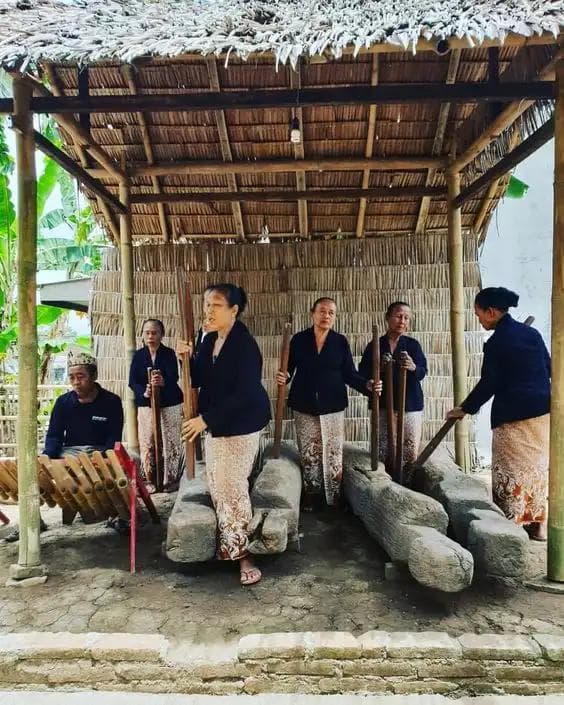
You can enjoy a variety of hands-on cultural experiences, including learning the Gandrung dance, playing gamelan, weaving bamboo crafts, carving Mount Ijen sulfur souvenirs, and joining an eco print workshop.
Where can I learn the Gandrung dance in Banyuwangi?
Osing Kemiren Tourism Village is one of the best places to learn the traditional Gandrung dance directly from local instructors while also understanding its cultural significance.
Can beginners join a gamelan class?
Yes. Gamelan sessions in Kemiren are beginner-friendly and suitable for visitors of all ages, even if they have no previous musical experience.
Where is the center of bamboo weaving in Banyuwangi?
Gintangan Village is known as Banyuwangi's bamboo weaving center, where visitors can learn traditional weaving techniques from local artisans.
What are Mount Ijen sulfur carvings?
They are handcrafted souvenirs made from natural sulfur collected from Mount Ijen and carved by local artisans into decorative items and keepsakes.
Can sulfur souvenirs be taken on an airplane?
Many airlines restrict sulfur-based items in cabin baggage. It is best to check your airline's regulations before purchasing them as souvenirs.
What is eco print, and where can I try it in Banyuwangi?
Eco print is a natural textile printing technique that transfers the shapes and colors of leaves and flowers onto fabric. You can experience eco print workshops at Sekar Jagad Batik & Creative Hub.
Are these creative activities suitable for children?
Yes. Most activities are family-friendly and can be enjoyed by children with appropriate supervision and guidance.
How many days should I plan to experience these activities?
Since the activities are located in different parts of Banyuwangi, spending two to three days allows you to enjoy them at a relaxed pace.
Do I need previous experience to join these activities?
No. All activities are designed for beginners and are guided by experienced local instructors and artisans.
Why should I try more than one creative activity in Banyuwangi?
Each activity introduces a different aspect of Banyuwangi's culture, helping visitors gain a deeper appreciation of the region's artistic traditions while supporting local creative communities.
Can these cultural experiences be combined with nature tourism?
Absolutely. Many travelers combine creative workshops with visits to natural attractions such as Mount Ijen, Red Island Beach, and other destinations around Banyuwangi.
The Osing tribe is far more than an ordinary ethnic group — they are the guardians of Banyuwangi's cultural identity, rooted in the long history of the Blambangan Kingdom, living on through language, tradition, and art carried across generations. Understanding the Osing tribe means understanding the roots behind much of what we now recognize as distinctly "Banyuwangi," including the batik motifs and Gandrung dance now known worldwide. Want to explore further into the history that shaped this identity? Read Puputan Bayu: The Battle That Gave Banyuwangi Its Name, or discover the story behind The Origin of Banyuwangi's Name: Legend and Historical Fact.