
Among the many folktales of East Java, the story of Damarwulan and Minakjinggo is one of the most popular, retold across generations and even staged in various traditional performing arts. Interestingly, the story's antagonist, Minakjinggo, is depicted as the regent of Blambangan, giving this tale a direct connection to the history of the region that is now Banyuwangi.
This article retells the story of Damarwulan in full, while exploring the historical theory behind the legend's origins according to academics.
Unrest in Majapahit
As the story goes, the Majapahit Kingdom was ruled by a queen titled Ratu Ayu Kencana Wungu, the kingdom's sixth ruler, also known as Dewi Suhita. Under her reign, Majapahit had conquered many territories, bringing them under the rule of the kingdom centered in Trowulan.
But that peace was disturbed by the ambition of a regent from one of Majapahit's conquered territories: Minakjinggo, ruler of the Blambangan regency, known for his great power. Minakjinggo was determined to marry Ratu Kencana Wungu, despite her firm rejection. This rejection enraged Minakjinggo, prompting him to plan a rebellion, even threatening to attack Majapahit's very center.
The Rise of Damarwulan
Facing this threat, Ratu Kencana Wungu held a contest: whoever managed to defeat Minakjinggo would receive a great reward from the kingdom. Amid this crisis emerged a village youth named Damarwulan, who at the time worked as a horse caretaker for his own uncle, Patih Logender — the man who had taken over as Majapahit's patih (regent) after Damarwulan's father.
Damarwulan's presence at Patih Logender's household wasn't welcomed by the patih's two sons, Layang Kumitir and Layang Seta. But Patih Logender's third child, Dewi Anjasmara, welcomed him warmly, and the two eventually fell in love and married.
Upon hearing of a powerful young man named Damarwulan, Ratu Kencana Wungu asked Patih Logender to let his son-in-law fight against the ruthless Minakjinggo.
A First Battle That Ended in Defeat
Damarwulan then went to face Minakjinggo in Blambangan, delivering a challenge to duel as Ratu Kencana Wungu's envoy. Minakjinggo, dismissive of Damarwulan's build, which was nowhere near as sturdy as his own, accepted the challenge with mocking laughter.
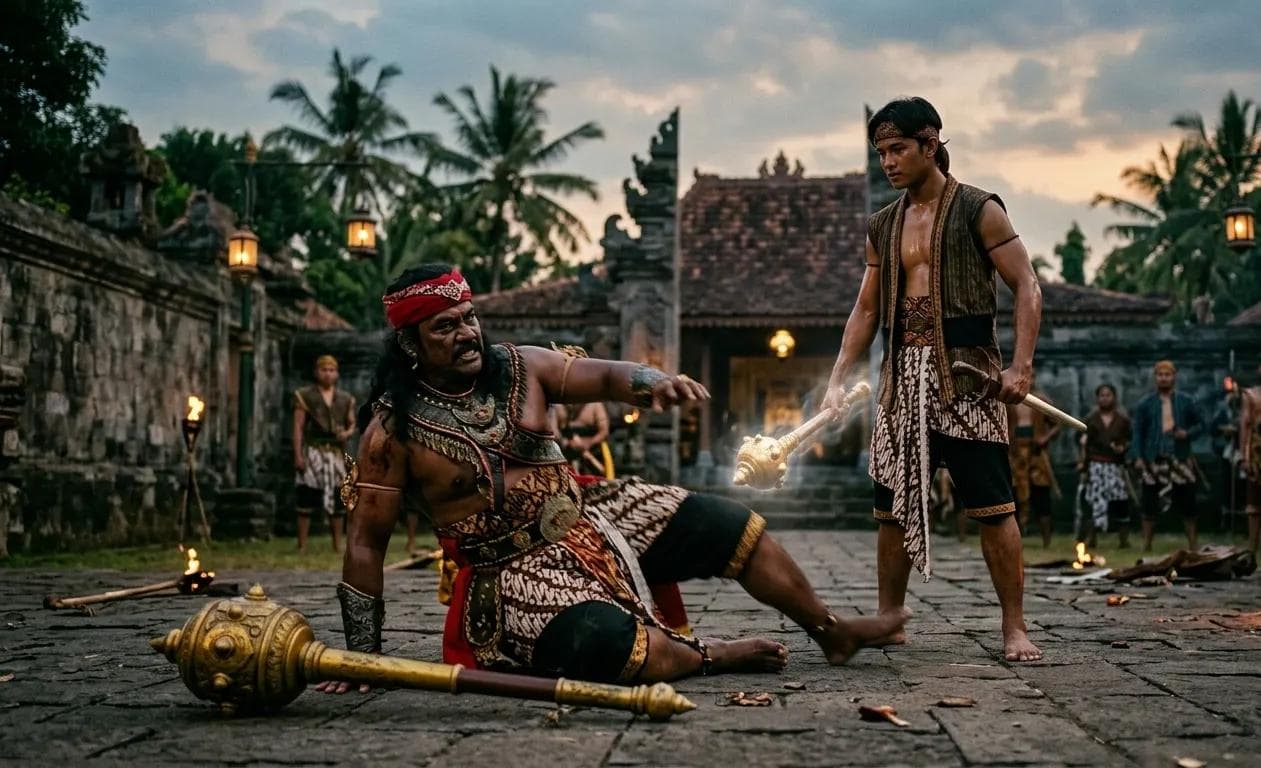
Wielding his signature weapon, the Gada Wesi Kuning (Yellow Iron Mace), Minakjinggo immediately struck the unarmed Damarwulan. Damarwulan fell unconscious, accompanied by Minakjinggo's triumphant laughter, who then celebrated his victory with a feast until he fell into a deep sleep.
A Scheme to Turn the Tables
This is where the story's turning point occurs. With help from within Minakjinggo's own palace, the sacred *Gada Wesi Kuning *weapon was stolen while the regent slept soundly, and handed over to Damarwulan. Damarwulan then challenged Minakjinggo to fight once more.
Minakjinggo was utterly shocked to see his own sacred weapon now in Damarwulan's hands. Without it, he could offer no meaningful resistance, and was ultimately killed by his own weapon. Damarwulan then beheaded Minakjinggo to present to Ratu Kencana Wungu as proof of his victory.
Betrayal Along the Way
On the journey back to Majapahit, Damarwulan was ambushed by Layang Seta and Layang Kumitir, who had secretly followed him to Blambangan. The two brothers tried to seize Minakjinggo's head so they could falsely claim the contest's victory before the Queen — a lie Damarwulan firmly refused to allow.
A fight was inevitable. Witnessed directly by Ratu Kencana Wungu and all the people of Majapahit, Damarwulan defeated both brothers. Their lie was exposed before the entire court, and both were thrown into prison as a consequence. Damarwulan, as the true victor, then earned the right to marry Ratu Ayu Kencana Wungu.
The Historical Background Behind the Legend
What makes this story worth examining further is the academic theory surrounding its origins. According to research published in the KRONIK journal (Surabaya State University), historians J.L.A. Brandes and Slamet Mulyana argue that the story of Damarwulan and Minakjinggo was most likely inspired by the Paregreg War (1404–1406) — a civil war over Majapahit's throne that broke out after the death of King Hayam Wuruk.
According to this theory, the figure of Minakjinggo is believed to have been inspired by Bhre Wirabhumi, ruler of Majapahit's eastern territories (including Blambangan), who came into conflict with Majapahit's western court, then led by Wikramawardhana and Dewi Suhita.
The same research also notes that the author of the Serat Dhamarwulan was most likely a Mataram-era writer, and the story later gave rise to various other versions such as the Serat Kanda, Serat Blambangan, and the Langendriyan Mangkunagaran performance created in 1881 by R.M.H Tandhakusuma.
Blambangan in the Legend's Shadow
Interestingly, despite the antagonist role assigned to Minakjinggo, the same academic research also reveals that Blambangan's people at the time were known as a mighty (digdaya) society, with their own autonomous government (swatantra), and actually maintained good relations with Majapahit. This shows that Blambangan wasn't merely an ordinary satellite territory, but an important political and military partner within Majapahit's power structure — a context that enriches our understanding of why this story remains so popular and continues to be retold in Banyuwangi today.
Frequently Asked Questions
What is the folktale of Damarwulan?
The folktale of Damarwulan tells the story of a young hero who defeated Minakjinggo, the powerful ruler of Blambangan, after he rebelled against the Majapahit Kingdom.
Who is Minakjinggo in the story?
Minakjinggo is portrayed as the ruler of Blambangan who planned to rebel against Majapahit after Queen Kencana Wungu rejected his proposal.
Who was Queen Kencana Wungu?
Queen Kencana Wungu, also known as Dewi Suhita, was the sixth ruler of the Majapahit Kingdom who challenged anyone capable of defeating Minakjinggo.
How did Damarwulan defeat Minakjinggo?
With help from inside Minakjinggo's palace, Damarwulan obtained the sacred Gada Wesi Kuning and ultimately defeated Minakjinggo using his own legendary weapon.
Who is Dewi Anjasmara?
Dewi Anjasmara was Patih Logender's daughter who fell in love with Damarwulan and later became his wife.
Who are Layang Seta and Layang Kumitir?
They were Damarwulan's rivals who attempted to steal Minakjinggo's head and falsely claim victory before the queen.
How does the story end?
Damarwulan exposed Layang Seta and Layang Kumitir's deception, received the queen's recognition, and was rewarded for saving Majapahit.
Is the story based on real history?
Many historians believe the legend was inspired by the Paregreg War (1404–1406), although the story itself belongs to the tradition of Javanese folklore.
Who inspired the character of Minakjinggo?
According to several historians, Minakjinggo was likely inspired by Bhre Wirabhumi, a ruler of eastern Majapahit territories including Blambangan.
Why is this legend still popular today?
The story continues to be performed in traditional arts and remains closely connected to the cultural history of Blambangan, the predecessor of modern Banyuwangi.
The folktale of Damarwulan is far more than an ordinary heroic tale — it carries traces of real history about the dynamics of power between Majapahit's center and the Blambangan region, while also proving just how significant Blambangan's position was in East Java's history. Despite the antagonist role given to Minakjinggo in this legend, history records that Blambangan was in fact a powerful and respected territory. Want to understand more about the real history of the Blambangan Kingdom behind this story? Read The Blambangan Kingdom: Glory and Fall at the Eastern Tip of Java, or explore another legend from this region in The Legend of Sritanjung and Sidopekso: The Origin of the Word 'Banyuwangi'.