
Amid the dazzling costumes and spectacular choreography of the Banyuwangi Ethno Carnival, one corner offered a different kind of story—a modest yet meaningful booth presented by Pusat Batik Banyuwangi. Representing Sekar Jagad Blambangan, the booth was more than just a place to display and sell batik. It invited visitors to discover the craftsmanship, dedication, and cultural heritage behind every piece of authentic batik.
Throughout the event, the booth became one of the busiest attractions, especially for visitors who were curious to experience the batik-making process firsthand rather than simply admiring the finished fabrics on display.
Batik Collections on Display
Pusat Batik Banyuwangi showcased a diverse selection of batik collections to highlight the richness of traditional batik techniques, including:
- Batik Tulis (Hand-Drawn Batik) – Created entirely by hand using a canting, resulting in intricate details and a unique character in every piece.
- Batik Cap (Stamped Batik) – Produced using copper stamps to create consistent patterns, allowing for a faster and more efficient production process.
- Semi-Colored Batik – Combining manual coloring techniques with additional artistic processes to produce more varied visual effects.
- Batik Semi Tulis (Semi-Hand-Drawn Batik) – A combination of stamped and hand-drawn techniques, balancing production efficiency with handcrafted artistic touches.
- Batik Accessories – Including batik fabrics, scarves, and various accessories featuring distinctive Banyuwangi motifs.
The variety of collections was intentionally presented so visitors could see how a single batik motif can be interpreted through different techniques, levels of craftsmanship, and production methods.
Live Batik Demonstrations Attract Visitors of All Ages
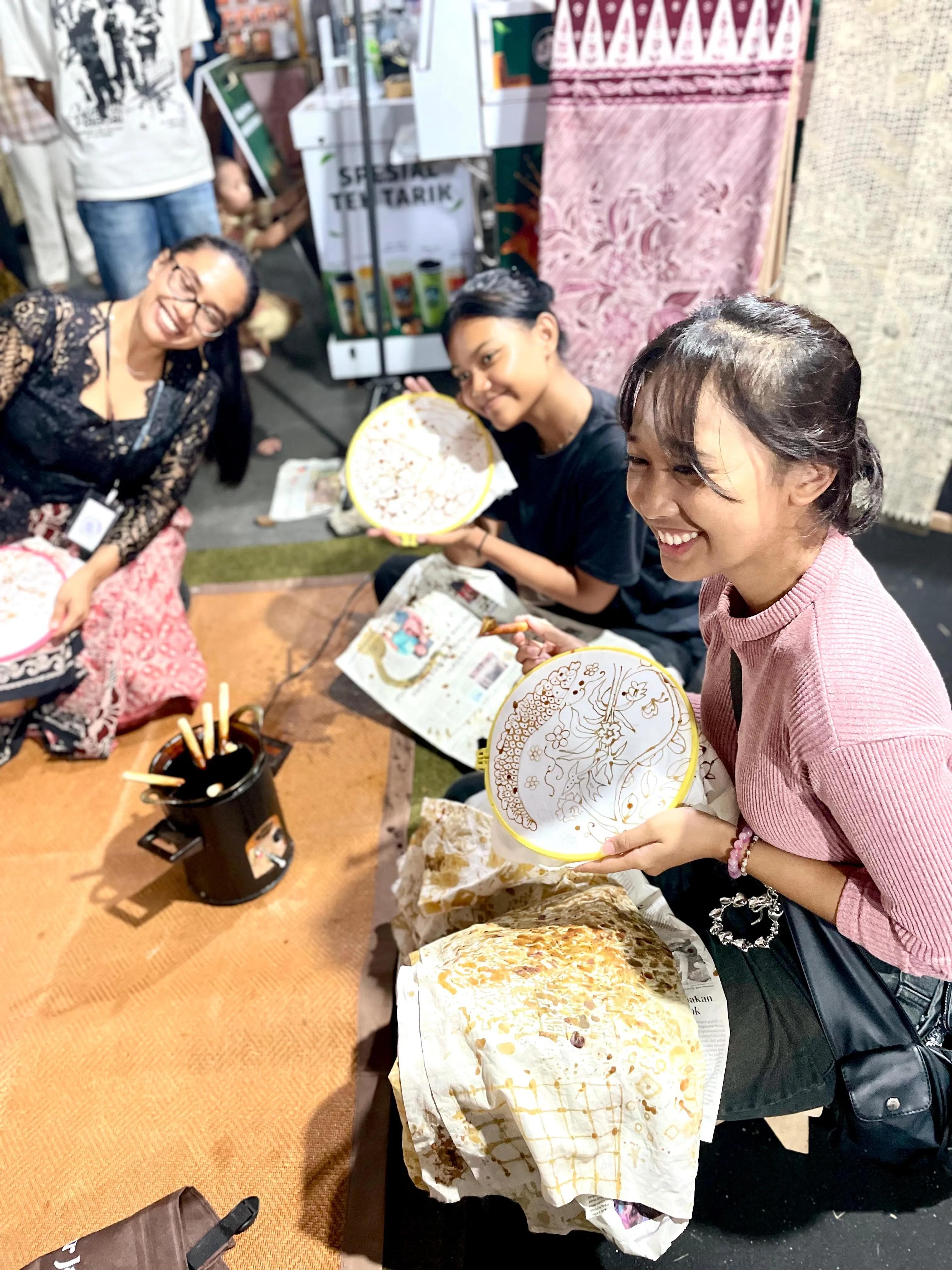
The booth's biggest attraction was the live canting demonstration. The Pusat Batik Banyuwangi team invited visitors to experience the traditional process themselves by holding a canting and applying hot wax (malam) onto fabric.
People of all ages eagerly took part—from children curious about the unique tool, teenagers looking for memorable experiences to share on social media, to adults who genuinely wanted to understand the craft behind authentic batik. Many visitors also asked detailed questions about how the canting works, the types of wax used, and the coloring techniques that create the rich shades and gradients found in traditional batik.
Growing Interest in Batik Workshops
Beyond trying the demonstration, many visitors asked whether regular batik workshops were available and expressed interest in learning more about batik coloring techniques in greater depth. These questions came not only from tourists seeking a memorable holiday activity but also from people who appeared genuinely interested in studying batik beyond the carnival itself.
For the Pusat Batik Banyuwangi team, these conversations served as an encouraging reminder that appreciation for batik as a cultural heritage remains strong—especially among younger generations who have fewer opportunities to witness traditional handcrafted techniques in an era dominated by mass-produced printed fabrics.
Why This Matters for Batik Preservation
At a time when printed fabrics with batik-inspired patterns are becoming increasingly common, the presence of a booth like this serves as an important reminder that authentic batik is much more than its visual design. Traditional batik involves a lengthy process of wax application, dyeing, and wax removal (pelorotan), with every stage requiring patience, precision, and skilled craftsmanship.
The enthusiasm shown by younger visitors throughout the event offers a positive sign for the future of batik preservation. As long as curiosity is nurtured and opportunities to learn continue to be created, the tradition of batik-making has every chance to thrive—not merely as a decorative pattern reproduced by machines, but as a living cultural heritage passed down from one generation to the next.
Witnessing the excitement of visitors of all ages at the Banyuwangi Ethno Carnival booth reinforced the Pusat Batik Banyuwangi team's belief that batik still holds a meaningful place in the hearts of younger generations. By continuing to inspire curiosity and providing spaces for people to experience the craft firsthand, the tradition of batik-making can continue to flourish despite the growing presence of industrially printed fabrics.
Frequently Asked Questions
What is the Pusat Batik Banyuwangi open booth at Banyuwangi Ethno Carnival?
It is an exhibition and live batik demonstration booth presented by Pusat Batik Banyuwangi, representing Sekar Jagad Blambangan, during the Banyuwangi Ethno Carnival. Visitors can explore authentic Banyuwangi batik collections and experience the batik-making process firsthand.
What batik collections are displayed at the booth?
The booth showcases a variety of Banyuwangi batik products, including hand-drawn batik (batik tulis), stamped batik (batik cap), semi-colored batik, semi-handmade batik (batik semi tulis), and various batik accessories.
What is the difference between batik tulis and batik cap?
Batik tulis is created entirely by hand using a canting tool, making each piece unique. Batik cap uses a copper stamp to apply repeating patterns, allowing for a faster production process with more uniform motifs.
What is batik semi tulis?
Batik semi tulis combines stamped and hand-drawn techniques in a single piece of fabric. This method balances production efficiency with handcrafted artistic details.
Can visitors try using a canting at the booth?
Yes. The Pusat Batik Banyuwangi team provides live canting demonstrations where visitors can try applying hot wax to fabric under the guidance of experienced batik artisans.
Is the batik demonstration only for adults?
No. The demonstration is open to visitors of all ages, and both children and adults enthusiastically participate in learning the basics of traditional batik making.
Are regular batik workshops available outside the carnival?
Yes. Pusat Batik Banyuwangi and Sekar Jagad Batik & Creative Hub regularly organize batik workshops for anyone interested in learning traditional batik techniques directly from local artisans.
How is batik colored after the waxing process?
After the wax patterns are completed, the fabric is colored through dyeing or hand-painting techniques. The wax is then removed through a boiling process called pelorotan, revealing the final batik pattern.
Why is it important to preserve hand-drawn batik?
Hand-drawn batik represents generations of craftsmanship, cultural knowledge, and artistic tradition that cannot be replicated by mass-produced printed fabrics. Preserving batik tulis helps keep Indonesia's cultural heritage alive.
Are younger generations interested in batik today?
Yes. The strong enthusiasm at the booth showed that many young visitors were eager to try canting, learn about batik-making techniques, and ask about future workshops.
What is Sekar Jagad Blambangan's role in this activity?
Sekar Jagad Blambangan supports the initiative through Pusat Batik Banyuwangi by promoting Banyuwangi batik, educating visitors, and encouraging the preservation of local textile heritage.
Where can I learn batik if I missed the booth at Banyuwangi Ethno Carnival?
You can join batik workshops organized by Pusat Batik Banyuwangi and Sekar Jagad Batik & Creative Hub, where participants learn traditional batik-making techniques directly from local artisans throughout the year.
Witnessing the enthusiasm of visitors of all ages at the Banyuwangi Ethno Carnival booth, the Banyuwangi Batik Center team is increasingly convinced that batik still holds a place in the hearts of the younger generation. As long as this curiosity is nurtured and given room to grow, the tradition of batik-making stands a strong chance of enduring, safe from the threat of extinction posed by the onslaught of industrially printed fabrics.